Each year, the Florida Prize in Contemporary Art brings together artists working across Florida, inviting 10 artists or collectives to participate; an invited juror then selects one to receive the $20,000 award. OMA’s curatorial team surveys artists throughout the state, and over time, the exhibition has become the museum’s signature contemporary showcase. As OMA marked the Florida Prize’s 10th anniversary, the Prize has become an ongoing record of contemporary art being made here.
The 2025 Florida Prize, the eleventh edition, was curated by Coralie Claeysen-Gleyzon, the Dr. James Cottrell & Mr. Joseph Lovett Chief Curator at the Orlando Museum of Art, and juried by Rod Bigelow, Executive Director and Chief Diversity and Inclusion Officer of Crystal Bridges Museum of American Art in Bentonville, Arkansas. Nathalie Alfonso received the award in recognition of her practice that included LineScape—Onset, a monumental site-specific drawing spanning 87 feet wide by 17 feet high across an entire gallery wall.
Across the 2025 exhibition, ten artists returned to ancestry and personal memory, belonging and displacement, the natural and virtual environment, urban change, and the labor of making the unseen visible. Those threads offered a way back into the exhibition as a cohort shaped by memory, material, place, and the question of what becomes visible when an artist insists that we look again.
Nathalie Alfonso: LineScape—Onset

Visitors first encountered Nathalie Alfonso’s LineScape—Onset as scale: an 87-foot-wide, 17-foot-high pastel drawing across the gallery wall itself. It was not an artwork hung on a surface, but a surface transformed through three weeks of continuous bodily action. And when the exhibition closed, it was gone, existing only in the space it was made for, and only for the duration of the show. That ephemerality is not incidental; it is part of the work’s meaning.
“Nathalie Alfonso is a Colombian-born artist whose approach to art is an embodied, process-driven experience,” writes Coralie Claeysen-Gleyzon, Chief Curator at OMA. “Her work is rooted in the intensive, laborious practice of gestural drawing,” transforming spaces through “repeated and controlled bodily movements.” Claeysen-Gleyzon also places Alfonso in a lineage with Lee Krasner and Cy Twombly, artists who used gesture “to transfer emotion and physicality” into painting and drawing.
That physicality comes from lived history as well as art history. Claeysen-Gleyzon notes that Alfonso trained as a competitive athlete in Colombia and later worked as a house cleaner after emigrating to the United States. Through “brushing, scrubbing, polishing, waxing, rinsing, on repeat,” cleaning became “a form of embodied research,” making Alfonso aware of “the invisibility of the ‘little hands’ that work tirelessly behind-the-scenes.”
The work’s grid lines echoed the gallery’s ceiling grid and unseen wall studs, while the scrubbing and washing away of charcoal and graphite spoke to unseen domestic labor. Claeysen-Gleyzon connects the work’s misty atmosphere to Alfonso’s bike rides through the Florida Everglades and to “the fragility, vulnerability, and transience of our environment.”
Her interpretation lands the work’s place in the exhibition: “At its core, Alfonso’s practice is about making the unseen visible.” Read more about Alfonso’s winning work and process in OMA’s feature on the 2025 Florida Prize winner.
Amanda Linares: Yo vengo de todas partes, y hacia todas partes voy
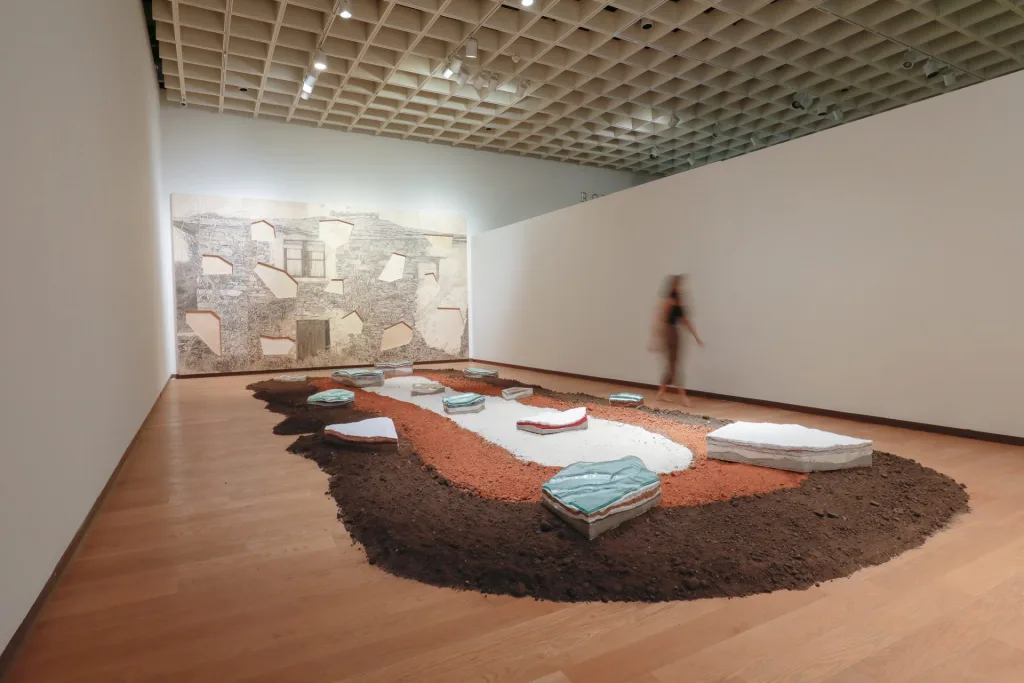
Amanda Linares’s installation surrounded viewers with a range of materials, including graphite, wood, soil, concrete, plaster, glass, fabric, wallpaper, resin, sand, and more, to create an immersive environment rather than a single work. The title is taken from Cuban poet and revolutionary, José Martí, “I come from everywhere, and toward everywhere I go,” signaling that this installation is about movement, multiplicity, and belonging without being anchored.
As Claeysen-Gleyzon writes in her essay on Linares, the work suggests “that we are all shaped by invisible forces — migration, heritage, displacement, the environment of a home — and that by sifting through these sediments, we uncover not only where we come from, but where we are capable of going.”
“Cuban-born and Miami-based artist Amanda Linares was initially trained in printmaking and graphic design,” writes Claeysen-Gleyzon. Her practice now spans drawing, sculpture, and installation, often using materials “evocative of the landscape of Cuba.” Claeysen-Gleyzon describes Linares as an artist who “investigates how personal and collective histories—often fragmented or obscured—continue to shape the present.”
The installation grew from a photograph of Linares’s paternal great-grandfather’s home in Asturias, Spain. “Although Linares had never stood before the actual building,” Claeysen-Gleyzon notes, “the photograph became a portal through which she could access familial memory and ancestral connection.” Rather than recreate the home, Linares reconstructed “the feeling of reaching toward something just out of reach—an echo of home and heritage, filtered through time, space, and imagination.”
A graphite drawing of the ancestral façade anchored the installation, but pieces were carved away. Those absences reappeared as sculptural “sediments” made from concrete, resin, wallpaper, fabric, and glass. Linares explains that these sediments are “made of many things you can’t take with you when you move from place to place.”
The soil-covered floor also shifted during her performances as she stepped on the loose surface, softening divisions “between past and present, self and other, here and there.” Through Claeysen-Gleyzon’s framing, Linares’s work belongs to the exhibition’s broader conversation about migration, memory, and the search for home.
Lisu Vega: The Tree of My Memories / La Raíz que te abraza
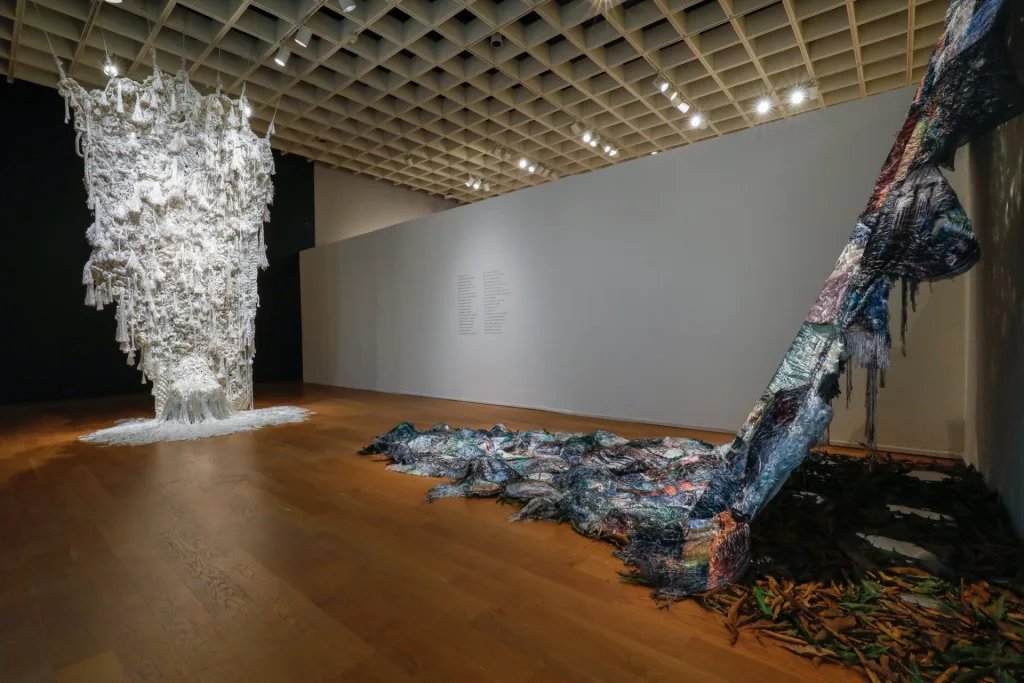
Lisu Vega’s works from The House of Her Memories series filled the gallery with fiber, photography, rope, and the visible shape of absence. The titles — The Tree of My Memories and La Raíz que te abraza, or “The Root That Embraces You” — gave memory a language of rootedness, reach, and return.
“Lisu Vega is a multidisciplinary artist who uses fiber as a medium to create emotionally resonant works that intertwine themes of memory, identity, migration, and sustainability,” writes Claeysen-Gleyzon. Vega’s connection to fiber began with her maternal grandmother, “a seamstress who taught Vega to sew at age six by making doll clothes from fabric scraps.” That early lesson became, in Claeysen-Gleyzon’s words, “a poetic strategy to re-weave the fabric of memory.”
Loss is central to the work. Following the loss of Vega’s grandmother to COVID-19 and the artist’s memory loss caused by perimenopause, Claeysen-Gleyzon writes of the “dual confrontation with forgetting — both personal and generational.” As she could not safely go back to Venezuela to visit her grandmother’s home, Vega commissioned photographs of the house, printed them onto fabric, and stitched the fabric together with the unraveled threads “at random, like the fragmented nature of memory itself.”
In the gallery, The Tree of My Memories rose 17 feet high, interpreting her grandmother’s white chair beneath a mango tree planted 65 years earlier. Claeysen-Gleyzon describes the empty chair as “heavy under the weight of grief, yet filled with possibility, elevation and light.”
Her closing language gives the work its place in the cohort: “Through every thread, knot, and photograph,” Vega’s work “maps a personal and collective terrain of memory, loss, and transformation.” Tulloch’s installation, one gallery over, carried that same concern outward from the family to the community, from private grief to public record.
Cornelius Tulloch: Porch Passages: Creole Collage
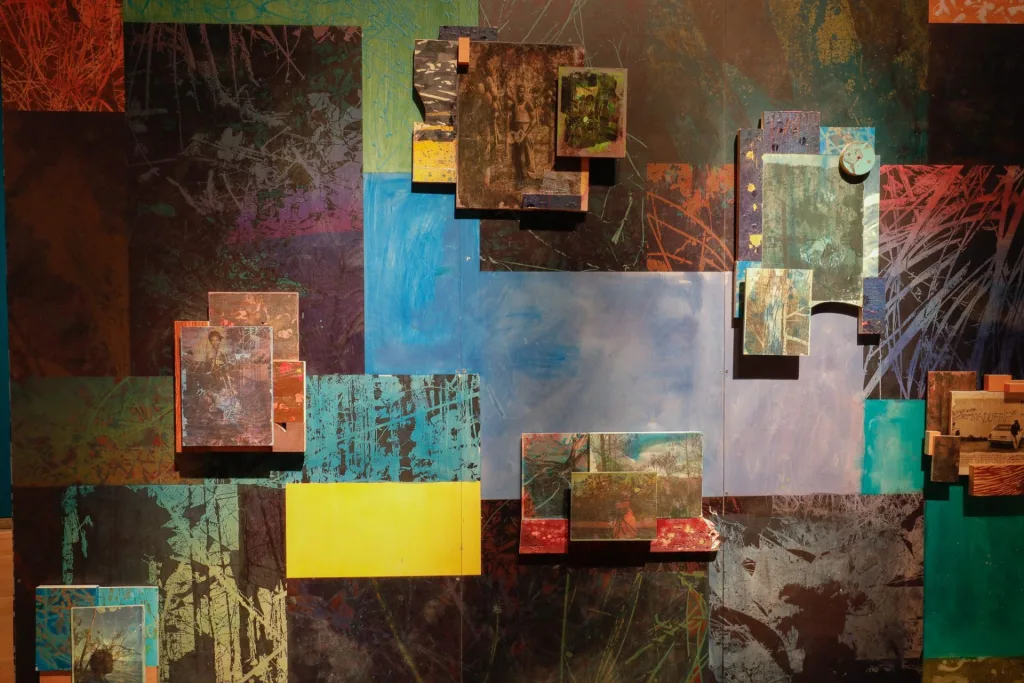
Cornelius Tulloch’s Porch Passages: Creole Collage invited visitors into a threshold: a porch between home and street, private memory and public life. As Claeysen-Gleyzon writes, Tulloch draws inspiration from creolization, “using it as a lens to develop a visual language that expresses the blending of African, Caribbean, and European influences.” The installation offers, in her words, “an invitation to dwell, to inhabit memory and position the built environment into a site of layered histories, hybridity, and imagined futures.”
“Cornelius Tulloch is a Miami-based interdisciplinary artist and architect whose work fuses painting, photography, and spatial design in large-scale installations,” writes Claeysen-Gleyzon. His practice, grounded in Jamaican and African American heritage, is informed by South Florida and Caribbean landscapes that exist “in a perpetual state of flux, between land and sea.”
The shotgun house gave the installation its structure. “In choosing the shotgun house — a form of vernacular architecture deeply rooted in the American South and Caribbean,” Claeysen-Gleyzon writes, Tulloch demonstrates “how built environments sustain culture and memory.” The archival photographs on the house’s walls are “more than ornamentation,” displaying “images of resilience.”
In his paintings, the members of the community appear to merge with the flora, in what Claeysen-Gleyzon calls a “symbiotic and fusional ‘dance’” that is “both liberating and protective” of those represented. Claeysen-Gleyzon relates this aspect of Tulloch’s work to the idea of Maroonage, in which the plants and animals provided cover for the escaped formerly enslaved individuals. For these individuals, blending with the environment was about “survival, adaptation, and resistance.”
The installation also embedded archival images made in collaboration with Black Miami-Dade and founder Nadege Green. These archives, Claeysen-Gleyzon writes, are “not passive records but active participants in reshaping how these stories are told—and who gets to tell them.” The work belongs in the exhibition as a meditation on place-making, public memory, and belonging.
Troy Simmons: Concrete, Memory and What Lies Beneath
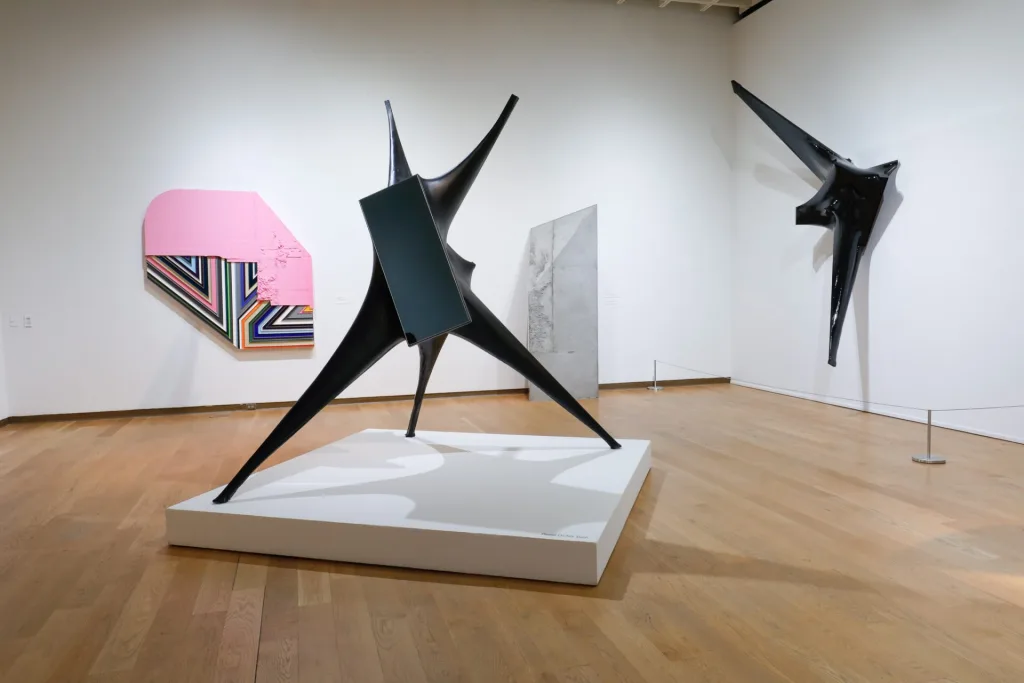
Troy Simmons’s installation met visitors through concrete surfaces, fractured forms, industrial materials, and flashes of color held beneath rough exteriors. The works brought the language of construction, demolition, and rebuilding into the gallery.
“Troy Simmons is a Miami-based sculptor and multimedia artist who has been active in the city’s art community for nearly two decades,” writes Claeysen-Gleyzon. Raised between Houston’s urban landscape and his grandfather’s East Texas farmhouse, Simmons first explored creative making in a handmade retreat with “dirt floors in some areas.” Claeysen-Gleyzon describes the duality “between the built and the organic” as central to his practice.
His early exposure to biology through his mother, a nurse, sparked “a fascination with the hidden world of microorganisms.” Later, environmental science and architectural technologies informed forms that resemble microscopic structures. Claeysen-Gleyzon describes his Durchbruch Hybrid Series — German for “breakthrough” — as “shape-shifting organic membranes” that fuse structure with “the unpredictable and malleable force of organic forms.”
The material process is equally important. Simmons uses tools and materials “drawn more from a job site than a traditional studio”: hammers, levels, chisels, concrete, aluminum, resin, auto paint, and reclaimed construction elements. Found concrete slabs are rebuilt, poured, cured, and subjected to “intentional acts of destruction,” a process that Claeysen-Gleyzon writes “echoes the palimpsest of urban landscapes—where decay, erosion, and reinvention coexist.”
Simmons notes that concrete “has become the evidence of the presence of humans on Earth.” Relocating to Miami in 2008 marked a turning point. As Claeysen-Gleyzon writes, Simmons describes experiencing “a cultural ‘splash’ — a vivid collision of new histories, communities, and colors” that began to infiltrate his palette.
He also documents the city’s disappearing structures, including vernacular buildings in the historically Black neighborhood of Overtown, through photography, video, and 3D modeling, transforming those ephemeral records into sculptural monuments.
His work in the 2025 Florida Prize asked viewers, as Claeysen-Gleyzon writes, “to consider what lies beneath the surface, both materially and metaphorically.” Arroyo’s paintings took that same city and tracked something more specific: a single marker, a single name, and what happened when the city quietly removed them.
Eddie Arroyo: Robert Francis Damien
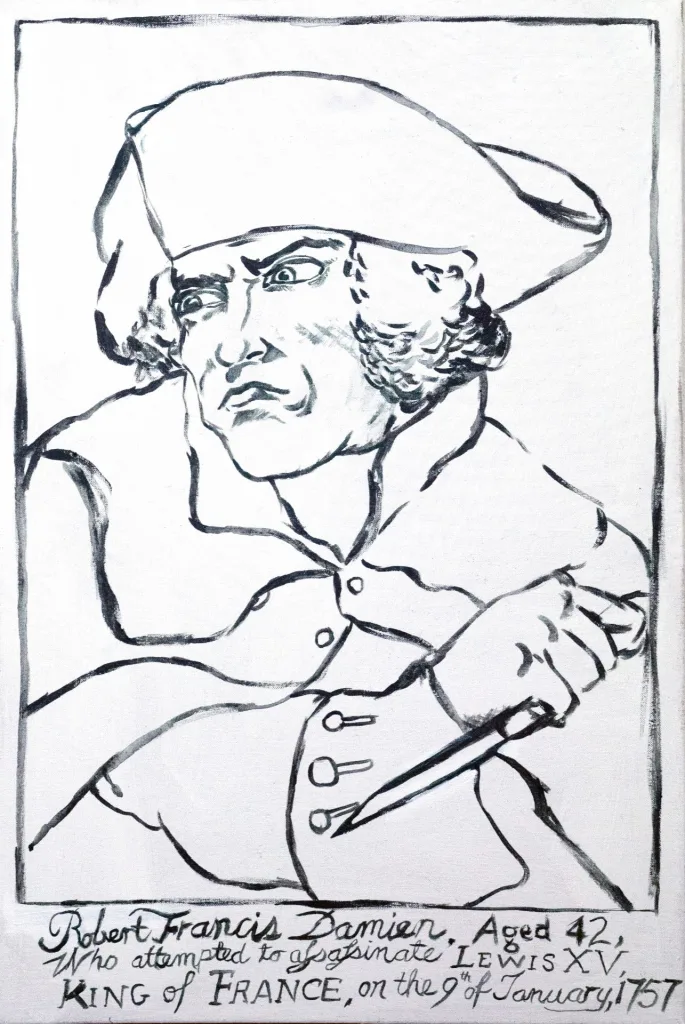
Eddie Arroyo is an artist whose work explores urbanism, gentrification, and the people displaced by development efforts, all of which are evident in his Instagram handle @developerssurvey. Painting carries its own weight in an exhibition built largely from installation work, and Arroyo uses it with careful precision.
Rendered in simple black sketch lines over white-primed linen, a departure from his usually bright, warm palette, the scenes are depicted, writes Claeysen-Gleyzon, like architectural renderings, incomplete plans that, Arroyo says, convey “an alarming sense” for many of the city’s residents.
“For the past 15 years, Eddie Arroyo has documented residential and commercial redevelopment in and around Miami,” writes Claeysen-Gleyzon, creating paintings that record “the city’s disappearing vernacular architecture and shifting identity.” His work, she writes, offers “a necessary commentary on the economic and social impact of gentrification in primarily Black and Latinx neighborhoods.”
For the 2025 Florida Prize, Arroyo documented the removal of a historical marker dedicated to Arthur Lee McDuffie. McDuffie was a 33-year-old African American man with three children who had served in the U.S. Marines. He was murdered by officers from the Dade County Public Safety Department in 1979.
When the marker came down in December 2024, Arroyo documented the site over four months. Claeysen-Gleyzon writes that the resulting series records “first, the caution tape on the pole; second, the tape’s removal; third, a bouquet of flowers placed in remembrance; fourth, the marker reinstated; and fifth, the marker seen from a different perspective.”
Arroyo paired that series with Robert Francis Damien (acrylic on linen, 36 x 24 in.), a portrait based on Robert-François Damiens, who was executed in France in 1757. As Claeysen-Gleyzon writes in her essay on Arroyo, Damiens was the last person publicly executed by drawing and quartering in France, and the account of his execution opens Michel Foucault’s Discipline and Punish, which marks its 50th anniversary this year.
Claeysen-Gleyzon explains the pairing directly: “Whereas McDuffie’s absence is glaring, erased on so many levels, Damiens’ face fills the canvas—placing the body back into the pictorial plane.” When Claeysen-Gleyzon writes about Arroyo’s references to Arthur McDuffie and George Floyd, she notes that Arroyo refers to them by their first names as a deliberate choice to “ground them in humanity.”
Arroyo’s work belongs in the cohort because, as Claeysen-Gleyzon writes, it “transforms erasure into a visible and dignified presence.” Lopez was doing something adjacent: her fiber portraits never let the viewer look away, either.
Kandy G Lopez: Fiber Portraits and Returned Gaze
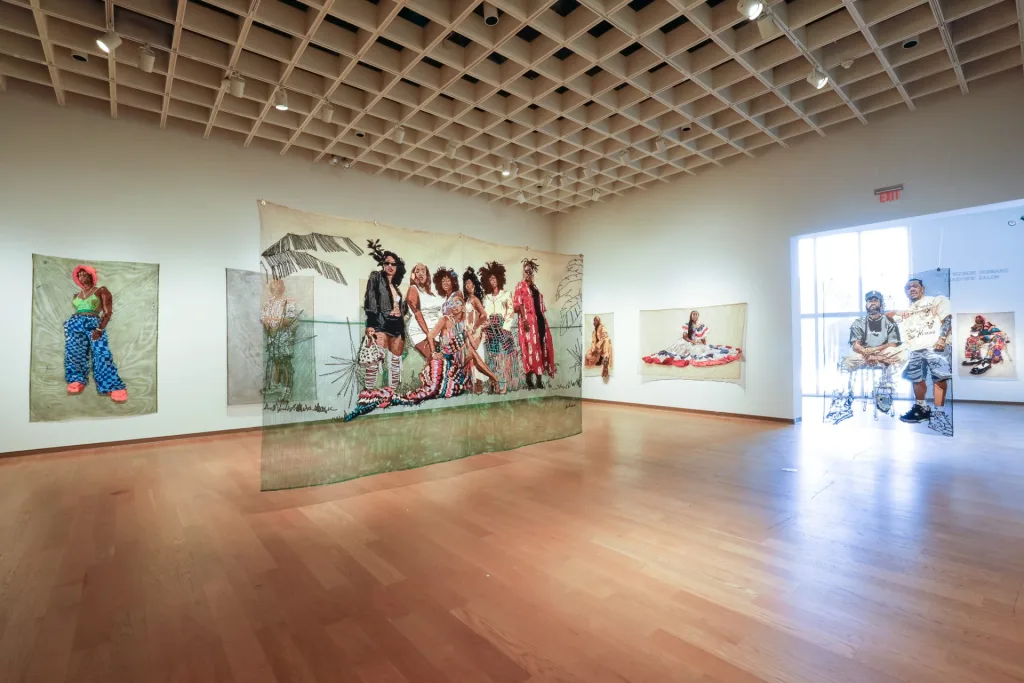
Lopez’s fiber portraits filled the gallery at life size and larger, each figure returning the viewer’s gaze directly and without apology. “Kandy G Lopez is a multimedia portrait artist based in Ft. Lauderdale primarily known for her work using fiber,” writes Claeysen-Gleyzon.
The artist’s early museum experiences were shaped by absence: she did not see “representations of people that looked like her.” Through her portraits of BIPOC individuals, she now works “to challenge and counter these traditional art historical depictions.”
Lopez’s sitters are people she knows or people she approaches because “they caught her eye.” Claeysen-Gleyzon quotes Lopez describing them as “the type of people when they walk into a room they take the air out, all eyes fall on them.” Her process shifts the relationship between sitter and viewer. She photographs her subjects while kneeling, so “they tower over her and have to look down at her,” giving them “dignity, status and a rank of honor.”
The portraits begin with the eyes, “a symbol of identity and the ‘window to the soul.’” Lopez wants viewers “to feel as if they stare at you from all over the room, because that way you can’t ignore them.” Claeysen-Gleyzon notes that “by returning the viewer’s gaze, the sitters assert their presence and claim their space.”
As Claeysen-Gleyzon notes in her essay on Lopez, fashion is a powerful connector in the work, one linked directly to the artist’s personal history. Lopez’s grandmother was a seamstress in the Dominican Republic, and the portraits intentionally celebrate the style and “swag” of their subjects through gold threads, cowrie shells, and elaborately rendered garments.
One portrait in the exhibition also features past Florida Prize artist Reginald O’Neal, a detail that quietly connects the 2025 cohort to the Prize’s own ongoing history. Within the 2025 exhibition’s concern for visibility, Lopez’s portraits “create new icons” that honor “the beauty and complexity of everyday people who have long deserved to be seen.”
Jiha Moon: Cultural Cartographies in Motion
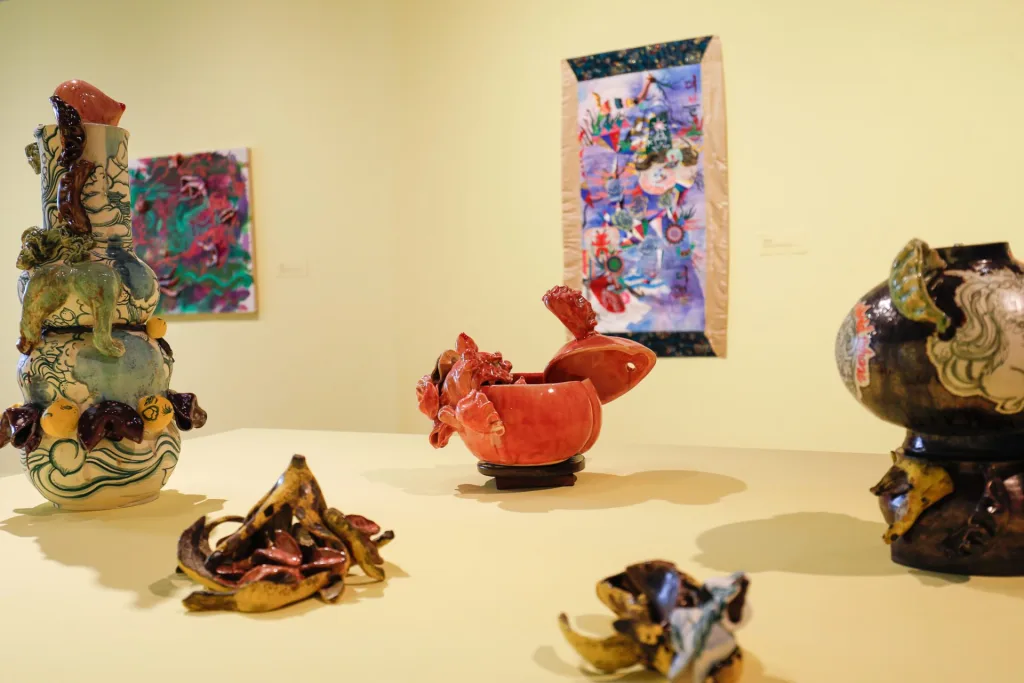
Jiha Moon’s installation filled the gallery with layered paintings, ceramics, textiles, collage, pattern, and pop-cultural symbols that refused to stay in one category. As Claeysen-Gleyzon writes, Moon’s work “maps the layered, fluid nature of identity in a globalized world, where symbols can shift meaning and origin depending on how they are viewed.”
“Korean-born artist Jiha Moon arrived in the United States in her mid-twenties and now finds herself balanced between two cultures,” writes Claeysen-Gleyzon, “spending half of her life in each, but feeling she belongs fully to neither.” That in-betweenness shapes a practice of “hybridity, ambiguity, and cultural duality.” Moon describes it plainly: “I am a cartographer of cultures.”
That cartography draws from traditional Korean painting, American tattoo designs, folk imagery, and pop culture. Claeysen-Gleyzon notes that Moon’s work brings together Roy Lichtenstein’s Brushstrokes, sailor tattoos, emojis, talismans, luxury branding, and even Keanu Reeves.
Symbols shift depending on context: a peach can refer to Georgia and Asian associations of longevity; a banana peel can suggest Warhol, camouflage, decay, and the exoticism projected onto Asian identity.
Moon’s ceramic works, paintings, and textiles also cross categories. Her fabric works are inspired by bojagi, a traditional Korean wrapping cloth, and are made in collaboration with her 98-year-old grandmother using hanji, acrylic paint, and repurposed cloth. “She taught me to be fearless,” Moon says.
Claeysen-Gleyzon describes Moon’s practice as “a celebration of multiplicity in all its forms: cultural, aesthetic, and material. In her layered, shifting worlds, nothing is fixed, and everything is alive with possibility.” That quality placed it in close conversation with Ladd’s work, which found a different kind of living force: the invisible one baked into the paper itself.
Kelly Joy Ladd: Divine Love
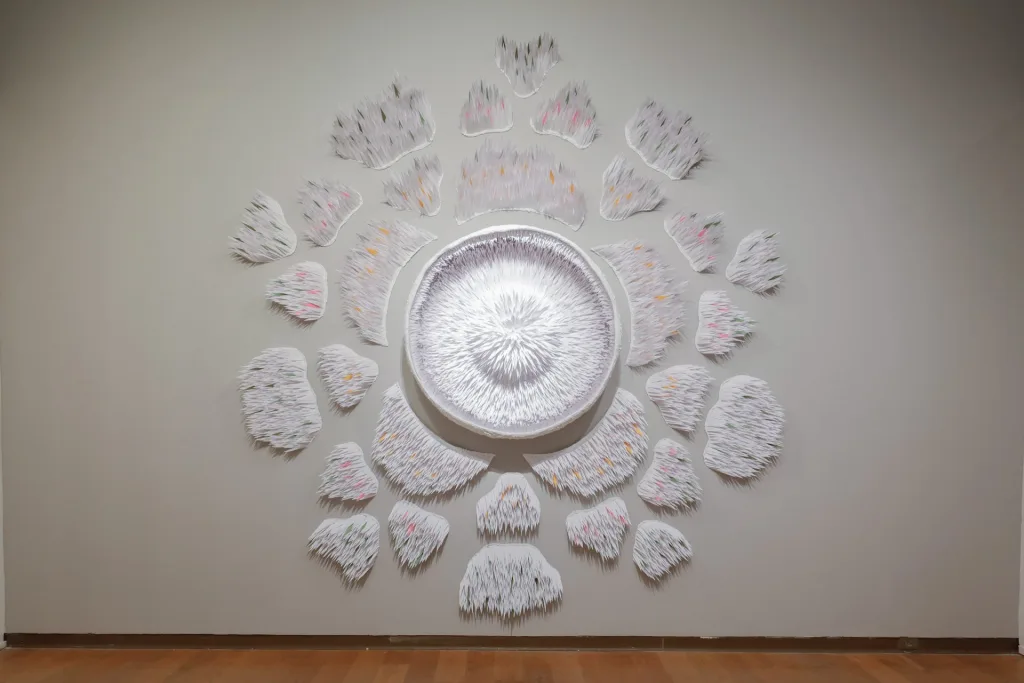
Kelly Joy Ladd’s Divine Love met visitors as a large paper-based work measuring 204 by 114 inches, monumental in scale, built from acid-free, lignin-free cardstock designed to be archival.
“Kelly Joy Ladd is a paper artist whose work explores our spiritual connection to the self, others, and the universe,” writes Claeysen-Gleyzon. Her background in liberal studies, Eastern philosophies, and meditation shaped her work deeply, as did a traumatic head injury in 2020 that affected her vision; unable to read, watch television, or look at screens during recovery, she devoted herself fully to art and meditation.
Ladd developed paper as her primary medium in response to her husband’s Lyme disease and his adverse reactions to chemicals and paint, a practical necessity that became, over time, the conceptual foundation of her practice.
Claeysen-Gleyzon describes the invisible aspects of the work directly: “Ladd uses energy as a medium, just like she uses paper or glue.” For more than a decade, Ladd has written her sacred words “Love, Joy, Wonder, Kindness, Compassion, Gratitude, and Peace” onto her canvases before layering materials over them. Those words become “a vibrational anchor, a sort of unseen, yet omnipresent, force within the work.”
The exhibition works expand that practice through ritual acts, including “burning old journals on the winter solstice, collecting soil from ancestral lands, charging crystals under a full lunar cycle.” Claeysen-Gleyzon writes that Ladd transforms “ordinary materials into vessels of sacred experience.”
Her work belongs in this exhibition through its sustained attention to energy, healing, and presence, and through a material logic that insists the invisible has weight. Castañeda’s work made a similar wager: that what you cannot physically touch can still be the most real thing in the room.
Leo Castañeda: Camoflux Mangrove Village 360
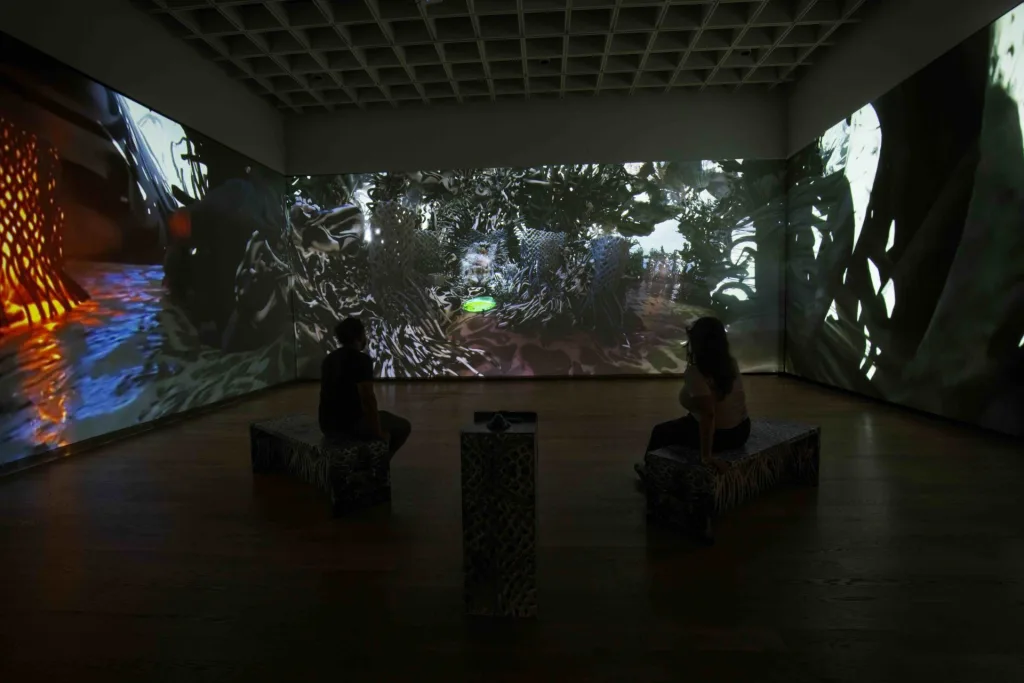
The title signals something immediately. Camoflux fuses camouflage and flux, concealment and change held in a single word. The mangrove, too, is a Florida ecosystem defined by its in-between quality: land and water, root and water, seen and submerged.
Leo Castañeda’s Camoflux Mangrove Village 360 asked visitors to enter an immersive, 360-degree digital environment rather than stand before a fixed object. To move through it was to become a participant in an evolving narrative, not a viewer positioned outside the work, but a presence inside it. The work joined painting, game design, ecology, and speculative storytelling into a single, navigable world.
“For over 15 years, multimedia artist and video game designer Leo Castañeda has been crafting a body of work that merges the physicality of painting with the immersive world of video game design,” writes Claeysen-Gleyzon. Presented in the Florida Prize, Camoflux is “a single-player adventure game that unfolds across hand-painted neo-primordial landscapes.”
The digital world begins in Castañeda’s paintings. Claeysen-Gleyzon explains that “every asset in Camoflux, from flowing mangrove biomes to sentient rock formations,” originates in paintings the artist created over the last decade and a half. These images are scanned, transformed into game environments, and embedded in “a richly interactive digital universe.”
The game opens from a mysterious explosion, the first painting Castañeda created 15 years earlier, and the “Big Bang moment” of an ecological apocalypse. Players navigate amphibious, androgynous beings and sentient terrain where “rocks breathe, air flows with agency,” and matter shifts between gas, liquid, and solid states. Even the first boss is not a conventional enemy, but “a vision of our future self.”
Claeysen-Gleyzon writes that the encounter is less about destruction than “negotiation,” asking players to adapt through observation, camouflage, vibrational terraforming, and electromagnetic sensing. Camoflux carried the exhibition’s environmental thread into a virtual world where survival depends on attention, adaptation, and relation. It was a fitting place for the 2025 Florida Prize to land: ten artists, ten different materials and methods, all of them asking what gets seen, what gets lost, and what it takes to make something last.
Looking Ahead to the 12th Annual Florida Prize
The 2025 Florida Prize showed a contemporary art scene in Florida that is varied, serious, and alert to the present. Across ten artists, the exhibition moved from ancestral homes to public markers, from fiber portraits to virtual mangrove worlds, from concrete fragments to an 87-foot drawing made only for that wall and that moment. The Florida Prize does not simply celebrate individual artists; it builds a cumulative record of what artists in this state are thinking about and making now.
That record continues with the 12th Annual Florida Prize in Contemporary Art, which marks the exhibition’s twelfth edition and, for the first time, includes two duos and twelve artists. The 2026 artists are Maria Theresa Barbist, Rose Marie Cromwell, Jason Hackenwerth, Meredith Laura Lynn & Katie Hargrave, Francisco Masó, Jessy Nite, Charo Oquet, Ema Ri, Mette Tommerup, and We Are Nice’n Easy. The exhibition is curated by Claeysen-Gleyzon and Katherine Page, Associate Curator at OMA, with Jade Powers, The Hugh Kaul Curator of Contemporary Art at the Birmingham Museum of Art, serving as the 2026 award juror.For visitors who saw the 2025 exhibition, the 2026 edition offers a reason to return with sharper eyes. For those who missed it, it offers another chance to see how artists working across Florida are using materials, images, memory, place, and language to describe the present. Learn more about the 12th Annual Florida Prize in Contemporary Art, become a member to stay close to OMA’s exhibition calendar, or plan your visit for the season ahead.