

By Coralie Claeysen-Gleyzon, The Dr. James Cottrell & Mr. Joseph Lovett Chief Curator, Orlando Museum of Art, March 2026
“The history of astronomy is a history of receding horizons,” observed Edwin Hubble, alluding to the expansion of our understanding of the universe since Copernicus and the rapid advancement of space technology ever since. Dennis Scholl’s exhibition A Day of Four Sunsets, however, temporarily asks us to move in the opposite direction: rather than emphasizing distance and scale, it brings us closer to the human experience of space as it exists in the collective imagination.
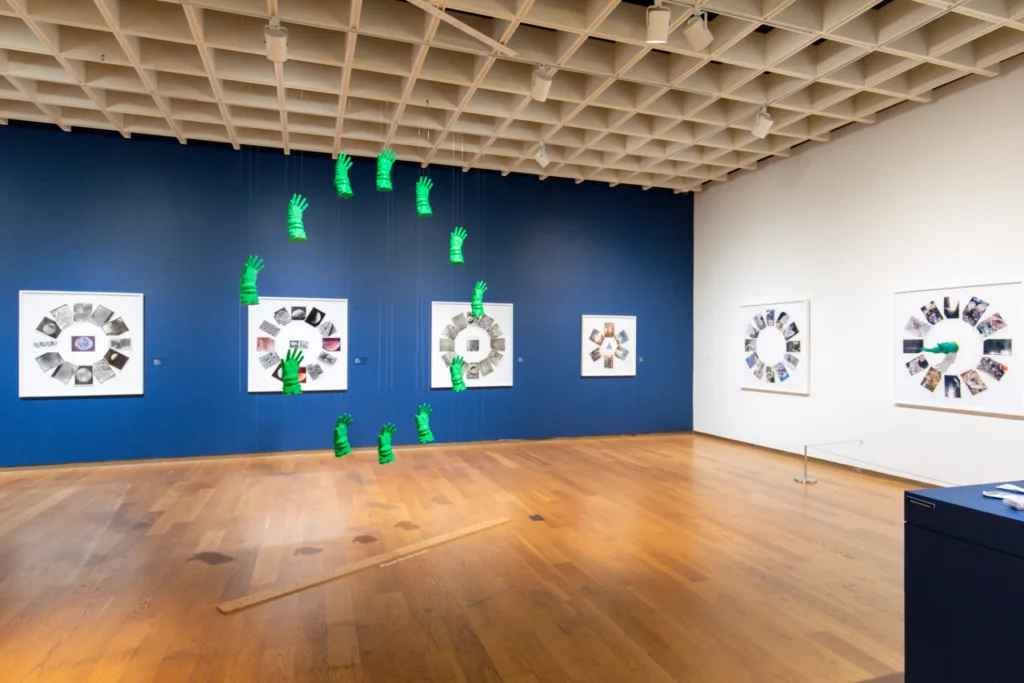
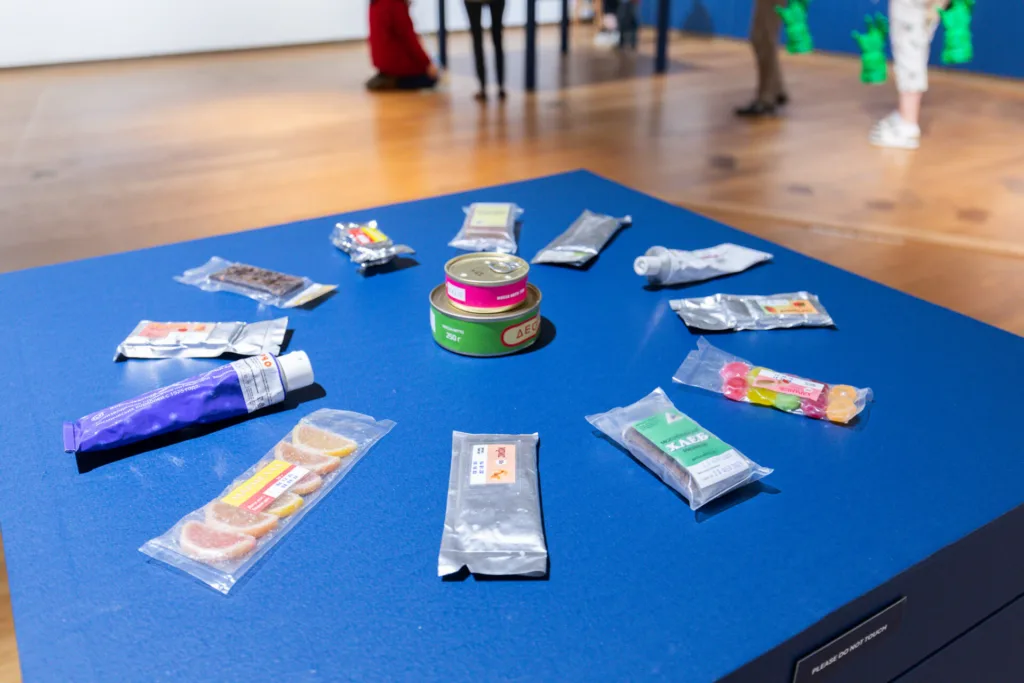
Through carefully assembled elements, such as photographs of a spaceship cockpit, the medical examination of an astronaut prior to launch, the tactile immediacy of a glove, and the modest rations designed to sustain life beyond Earth, Scholl constructs a deeply intimate encounter with space exploration. These objects, collected by the artist over several decades, serve as a conduit for shared emotional experience, drawing viewers into a sense of proximity to astronauts and their journeys.
The notion of collective memory is central here. It encompasses shared experiences and mental representations that transcend individual lives, binding people across cultures and generations. The moon landing, for instance, is not just a historical milestone but a moment of collective ownership—we put a man on the moon. This sense of participation and emotional investment reflects how collective memory fosters a sense of belonging and shared identity.
Scholl’s exhibition visually reinforces this unity through form and repetition. Each assemblage is meticulously organized into a dodecagonal structure, composed of twelve elements arranged in a circular configuration. The circle, long associated with perfection, unity, and cosmic harmony, evokes cycles of time and planetary motion. Its symbolism extends into sacred geometry, spirituality, and ancient cosmology: there are twelve zodiac signs, twelve disciples, twelve months in a year. Plato also associated the dodecagon with the quintessential structure of the cosmos itself, representing balance and totality.
This circular arrangement also echoes Scholl’s background as a filmmaker. The dodecagon subtly recalls the shape of a camera lens, suggesting the act of putting something into focus, looking, framing, and capturing an image. In this sense, Scholl invites viewers to pause, observe, and reflect. His work demands attention: to look at these objects and ponder the memories they carry.
The exhibition navigates a powerful emotional spectrum, juxtaposing moments of triumph with those of immense tragedy. The exhilaration of the first moon landing contrasts with the devastation of the Challenger explosion; both events etched into global memory, particularly for those who witnessed them live.
These shared occurrences, whether joyous or catastrophic, are bonding and binding experiences that allude to both humanity’s greatness and its sheer vulnerability; much like an astronaut tethered to a spacecraft, simultaneously embodying human achievement and existential fragility. It is that duality that pervades throughout the work.
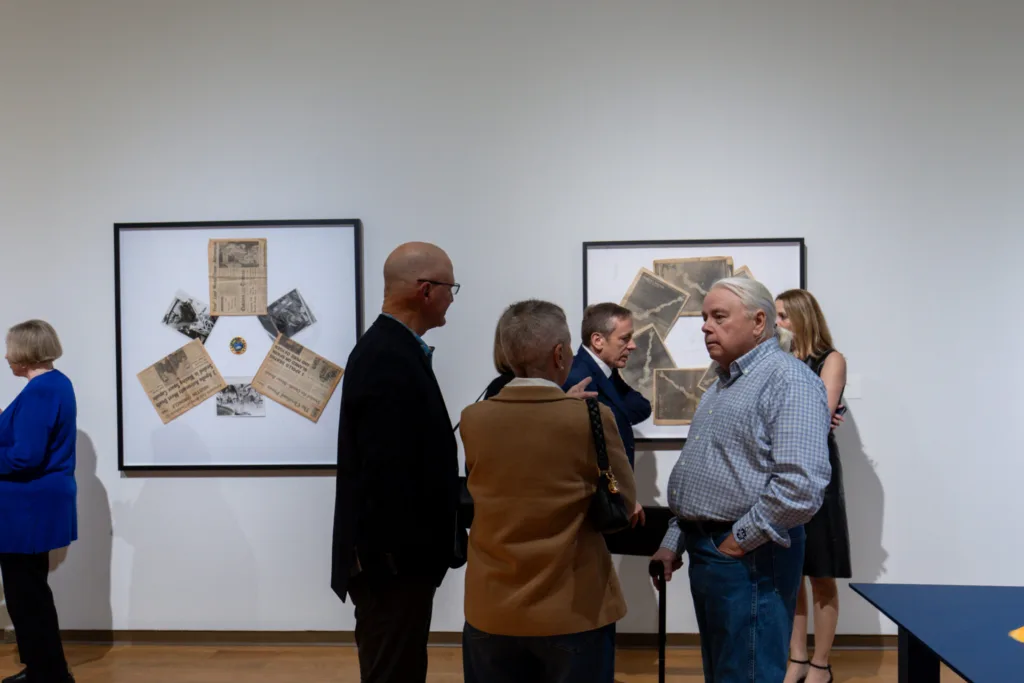
A Day of Four Sunsets balances opposing forces: closeness and vastness, pride and loss, power and insignificance. Each composition, composed of separate elements, curves inward and aligns into a cohesive whole. Like orbiting planets, the parts respond to one another, forming a harmonious system that mirrors both the cosmos and the collective human experience.
In Scholl’s work, the act of collecting memorabilia and space-related objects could also be an attempt to preserve memory against the erosion of time. These artifacts are testimonies, proofs that lend tangibility to experiences that were, and remain, accessible only to a select few.
The grain and scratched surfaces of photographic slides, the curled-up edges of aging prints, dented food cans, faded labels, and yellowed pages all bear the visible marks of time’s irreversible passage. In an era in which high-resolution images of launches, spacewalks, and astronomical phenomena are instantly accessible and routinely streamed directly into the palms of our hands through smartphones, these older objects carry a distinct sense of wistfulness.
These artifacts assembled into artistic compositions invite a form of romanticization and poetically remind us of what the dream of space exploration once was and of the triumphs and tragedies that shaped it. They anchor collective memory in a physical form, urging us to continue marveling at humanity’s extraordinary capacity to reach beyond Earth, to notice something as profoundly transformative as John Glenn’s experience of a day with four sunsets.
