

Written By: Coralie Claeysen-Gleyzon
Floridiana: Material Culture from the Sunshine State presents over 130 works from Gary Monroe’s extensive collection of Floridiana, painstakingly collected, researched and expanded upon over the course of many years. While these works offer a unique insight into the act of collecting, they also provide a portrait of a bygone Florida and prompt us to reflect on the stories and histories they convey. Floridiana tells “A” story of Florida. Not “THE” story, because it is through a continuous and consequential process of selection via the manufacturing, preservation, collecting, and eventually curation of these objects, that only a specific part of these items is on view in the gallery today.
This exhibition therefore attempts to draw a portrait of the Sunshine State through a plethora of disparate objects: from Florida’s cultural roots anchored in the land of Seminole ancestry and heritage, to its exoticization via citrus and theme park memorabilia, tourist souvenirs, commercial photography and roadside ephemera; to the “melting pot” character of a land in constant ebb and flow via cherished familial, devotional and spiritual items; and finally its creative output with self-taught Outsider art and other fragments of popular culture.
These objects are anchored in reality, because they testify to actual times, places, industries, people, and histories—some joyful and some more complicated. Yet these objects are also somewhat untethered from the real world; they float in the collective imagination of what Florida is “supposed” to be, since many were created to sell and preserve an image of Florida as a perfect land of leisure, sunshine, and exotic nature—an Eden on the U.S. Mainland, an endless escape. This Floridiana collection therefore transcends merely gathering traces and remnants of material culture, to instead assemble the portrait of a state suspended between memory and desire, myth and reality.
The state of Florida itself is both real and imagined; it is suspended between an increasingly rare, idyllic natural landscape and a series of dreamlike man-made environments, marketed through idealized memorabilia and kitschy souvenirs, rare finds and quirky tchotchkes, cultural treasures and commercial oddities. The collection reveals the blend of high and low culture that these objects contain. Beauty and cliché, nostalgia and exoticization, acclaimed appeal and controversial history can all coexist within the same space, that of a private collection, made public for the duration of an exhibition.
On the Object in a Collection and the Act of Collecting Material culture matters here because, in the context of this private collection, as opposed to a museum collection, everyday objects are the primary focus. These objects’ physical appearance—their color, surface, design, and form—turns abstract ideas about Florida as a place to be dreamt about into something solid, portable, and desirable. “One can easily see in an object […] a transformation of life into matter (matter is much more magical than life),” said literary theorist Roland Barthes in his seminal work Mythologies (1957). 1 For Barthes, the object is more magical than life because it is less fleeting, more permanent, enduring, and tangible.
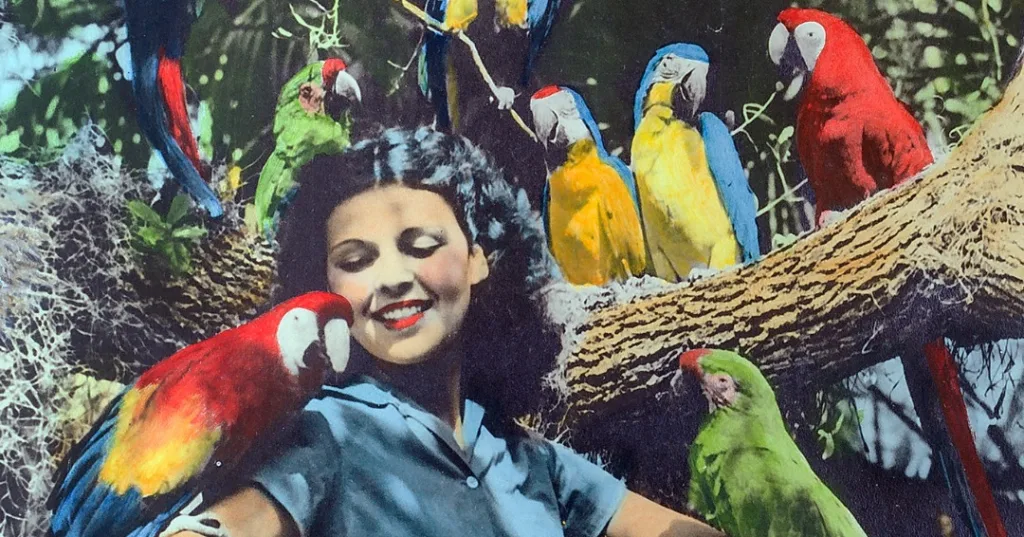
Life is packaged in an object of desire, much like Florida, land of leisure, is packaged in a vintage postcard of Parrot Jungle. It also strips away the messy reality of Florida’s environment (its humidity, swampy terrain, rapid development) and replaces it with a clean, magical “bourgeois myth” of eternal sunshine and tropical paradise. Floridiana becomes a sanctuary for daydreaming, inviting the mind to retreat into a remembered imagined landscape. The collection becomes less a neutral archive than a space of longing and imagination.
An invisible thread runs between the collector and the object: an irresistible pull, an attraction. Once their gaze falls on it, they desire it. The object seduces and expresses a lack, which leads to the urge to purchase, the impulse to collect. This desire sometimes begins long before the encounter, with a sort of hunt, a quest for a long-lost treasure, but it can also be a complete chance encounter. Objects in collections therefore exude the expression of a visceral desire.
There are many reasons for collecting; often, collectors seek the objects and the stories they tell. Collected objects, however, also belong to a multilayered system of values outlined by sociologist and philosopher Jean Baudrillard in The System of Objects (1968). He identifies four values: “use value,” an object’s practical, functional purpose; “exchange value,” its economic worth; “sign value,” its role in conveying social status and prestige; and “symbolic exchange value,” its emotional or relational meaning. 2 In Floridiana, a single vintage Florida object can simultaneously embody a historical truth, a cultural myth, a social status symbol, and a vessel for deep personal nostalgia. Monroe therefore shares with us more than just a collection of Florida-found objects; he has indeed assembled and collected over the years the “Myth of Florida” and, in so doing, has become an important steward of the history and story of The Sunshine State.
Sources:
- Roland Barthes, Mythologies, trans. Annette Lavers (New York: Hill and Wang, 1972), 88.
- Jean Baudrillard, The System of Objects, trans. James Benedict (London, New York: Verso, 2002).
