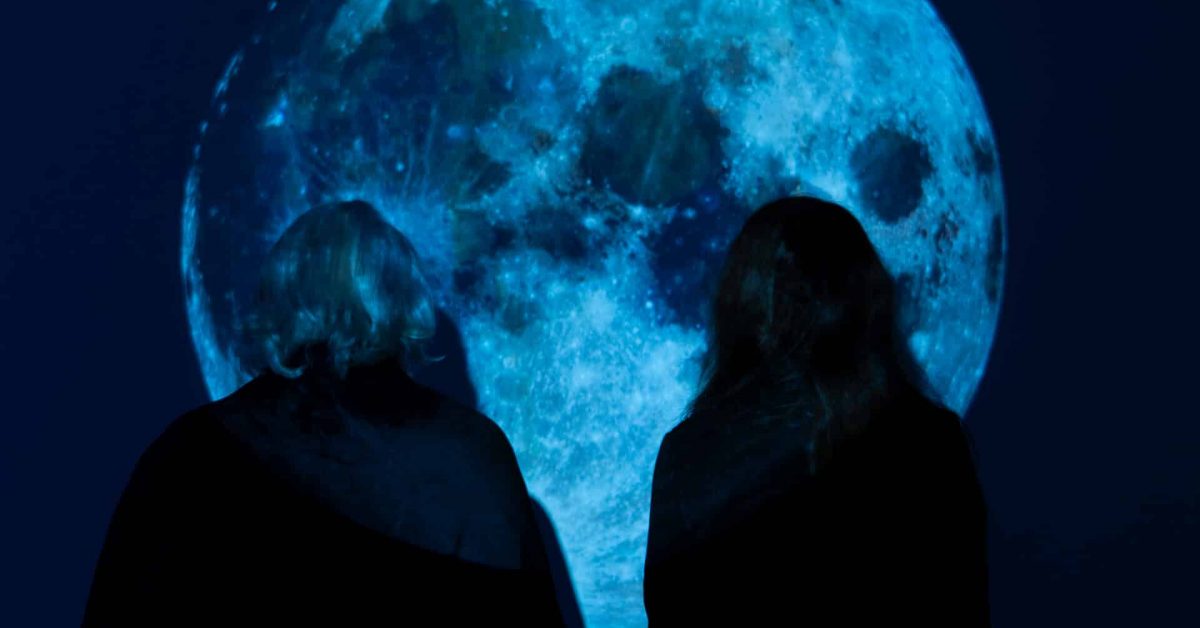
There’s a physical reaction that just about all of us experience when we see a photograph of Earth from space. Maybe you’ve felt it when you first saw the classic NASA photograph, Earthrise, or maybe when you watched an ISS live stream, or you felt it from a new deep space telescope image that looks too dreamy to be real. However it happens, NASA images inspire artists by giving us a new perspective on our world.
It’s not a new trend. For decades, art about space exploration has shifted the perception of time, space, and our place in the universe. NASA art and space art of every kind continue this tradition today in new and exciting ways.
Dennis Scholl is one such artist, and his exhibition at the Orlando Museum of Art delves into the poetry of space exploration through assemblages of materials related to NASA. His contemporary work shows us how art inspired by space is rooted in history, curiosity, and that same mystery that draws us to the stars.
The Allure of the Cosmos
There is something sublime about space. Its vastness isn’t something you can walk into, and its darkness you can’t measure with your eyes. It’s a place where time is physical and warped by gravity. While looking at an image of space, your mind is processing its immensity: horizons of dust clouds that span millions of miles and a tenuous line back to Earth that makes everything we love back home both resilient and fragile.
That introspection is part of the attraction of NASA art for artists and viewers. It is the product of scientific instruments, missions, and data, but it also reads as an aesthetic composition. Color, framing, and texture matter. Sometimes the image may be impossibly detailed or grainy and historic. It may also be the computational approximation of visible wavelengths. In any case, space art sits at an interesting place where fact encounters feeling.
Artists keep coming back to cosmic art because it naturally frames themes that are deeply human:
- Size: Daily life feels smaller, more precious.
- Time: Orbits, space-time, mission length, memories are put into perspective
- Exploration: The impulse to reach out and ask questions
- Shared memory and collective consciousness: Images that mark a generation
And there’s something universally accessible about space images. They’re not just for experts; they’re for anyone who looks, thinks, and asks, “What am I seeing?” NASA’s public collections make the point especially approachable. They offer a vast trove of public-domain images reflecting humanity’s common desire to better know the universe.
A Brief History of Space-Inspired Art
Long before we sent cameras into orbit, images of “space” were made through astronomical drawings, early telescopic images, and science fiction illustrations in which space was treated as a stage for speculation. In these pre-space age images, space was imagined, interpreted, and invented.
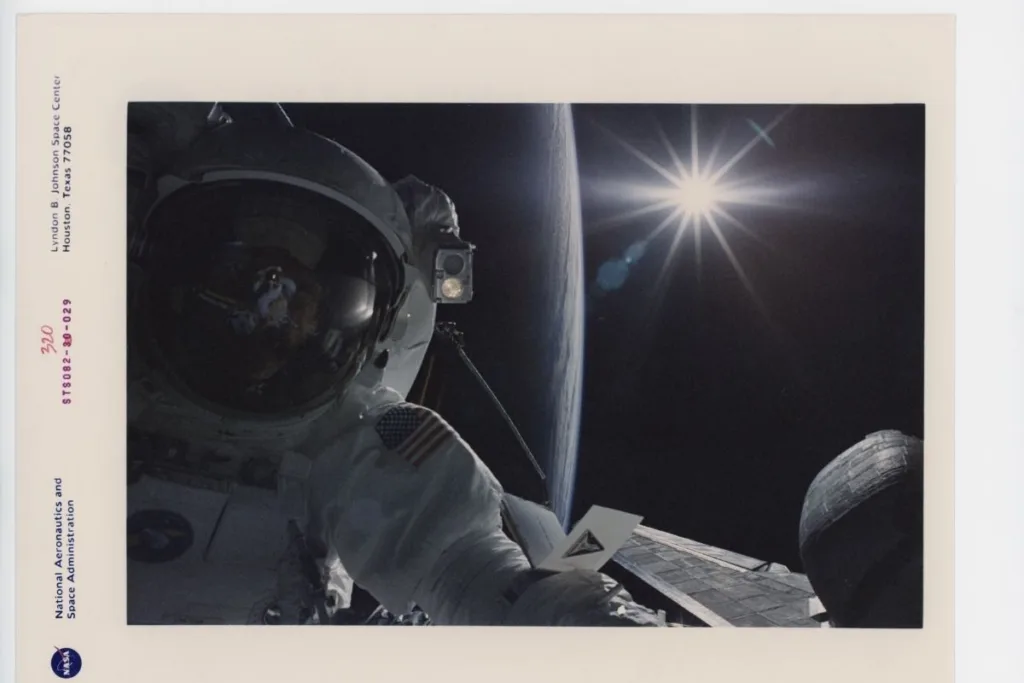
The Space Race made it real. And artists responded with celebration, skepticism, and interest in the emotional consequences of a new perspective. NASA had realized early on that art could communicate the human side of exploration, and it started its own NASA Art Program in 1962. Administrator James Webb invited artists to interpret missions in their own way.
A few important examples from the Space Race period illustrate how space entered the art world of the modern era. Robert Rauschenberg’s Stoned Moon series (1969–70) was a series of lithographs on paper, made from Apollo 11 photos but also layered with the artist’s own marks.
Space exploration art quickly became a manifestation of modern mythology. Andy Warhol’s Moonwalk (1987) is one image discussed as a late-career rumination on a televised cultural moment, made from NASA images and collective memories of the Apollo years.
In more recent years, sources and techniques for space images have proliferated. Artists are now using:
- Actual NASA-related materials and mission memorabilia
- Satellite and Earth observation images
- Collaborations between art institutions and space agencies
- New imaging techniques, as raw data is rendered into stunning images
This history is worth knowing because art conveys something that technological achievement does not. Space exploration is not only technical, but also existential. It touches on ambition, progress, our limits and capabilities, and what it means to see our place in the universe. Art inspired by space gives us ways to ask and answer that question.
Dennis Scholl and the Poetry of Space Artifacts
Dennis Scholl isn’t exploring contemporary space art by painting it. He works with what’s left behind after space exploration: the objects, documents, and artifacts that turn history into something to hold and remember.
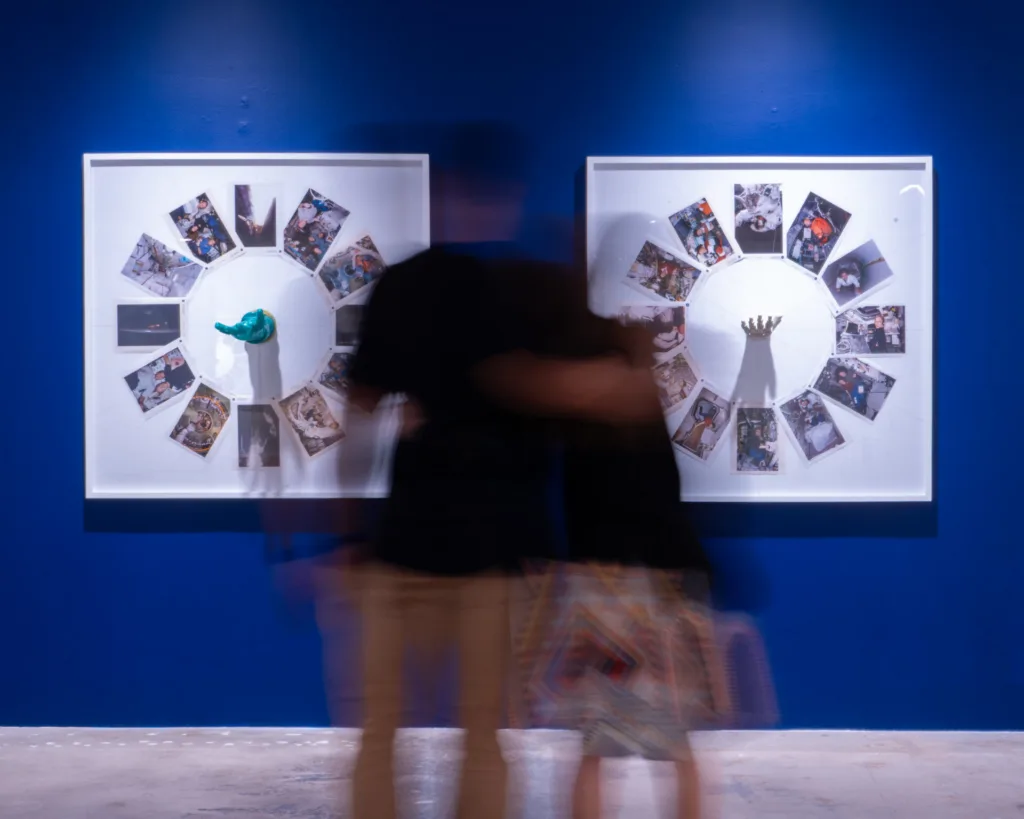
In Dennis Scholl: A Day of Four Sunsets, opening March 27, 2026, in the Mr. and Mrs. Chelsey G. Magruder II Gallery at the Orlando Museum of Art, Scholl explores the poetics of space exploration in assemblages of NASA memorabilia and related ephemera.
The title of the exhibition comes from astronaut John Glenn’s observation of multiple sunsets during his first orbit around the Earth in 1962. It was an experience that breathed humanity into space exploration art and turned it into a moment in time that can now be relived.
Scholl’s framing for the exhibition extends this idea with a quote from Antoine de Saint-Exupéry’s The Little Prince: “You know – one loves the sunset when one is so sad…” indicating that while beautiful, sunsets can also be bittersweet, combining wonder and yearning in a single moment. That duality resonates throughout the work, merging the incredible experience of space travel and the intimacy of memory.
The artifacts themselves offer further meaning. Scholl assembles mission patches, declassified documents, photographs, and newspaper clippings into captivating displays that offer new perspectives. They are the traces of memory and history. He often arranges the artifacts in a dodecagon, a twelve-sided polygon that can denote cycles and order, as in calendars and orbits.
What’s unique about Scholl’s work is how he retells history and collective memory with artifacts. It’s not simply marveling at what humans have accomplished; it’s also questioning what we remember, what we cycle through, what becomes myth, and what becomes something we can touch. Over a decade of careful collecting, he has built an archive that is neither a simple documentary nor purely an aesthetic experience. It lives in the space between.
Considered in this way, the unknown is not just out there in the cosmos. It is accessible in the stories we tell about human ingenuity, exploration, and what we hope to find beyond ourselves.

Why Space Still Fascinates Contemporary Artists
We’re in a new space age thanks to flashy private spaceflights, decades of roving Mars missions, and space photography art taken from deep-space telescopes that make their way to our phones, classrooms, and art studios. Space has rarely been more visible in everyday life, fueling fresh waves of art inspired by space, such as astronaut art, contemporary space art, and cosmic art.
Artists continue to ask questions through this medium that are both urgent and ageless. Some look to the “Overview Effect,” the phenomenon of seeing the Earth from above that can change how you see the world and what connects us all. Others examine the balance between what we can control, what we cannot, and what we choose to pursue.
As many artists find, using NASA art and space imagery makes exploration feel approachable and personal, no longer just a technical achievement, but a reflection of our own wonder and yearning to find out more about where we are and what it all means.
That’s why space-based art is such a powerful tool for families and educators looking to connect art with science. Science discussions can sometimes feel like a closed circle. Art opens it up, inviting observation, interpretation, narrative, and response, all ways of engaging that lead to further exploration.
Explore Space Art at OMA
Although most of us will never get the chance to see Earth from space, we can still have that moment where we pause, with awe and understanding, at images and art that shrink the stars to a more human scale. That’s the subtle power of space-inspired art: it makes space feel real.
You can connect with art and science in personal and meaningful ways when you visit OMA. Current exhibitions, such as Dennis Scholl’s, remind us that space is not just about the technology and the mission, but about experience and memory. What we remember, what we create, what we share, and what we wonder about together.
Stay informed about upcoming exhibitions and find ways to engage with events that blend creativity and education, offering enriching experiences for all. When we choose to embrace our curiosity about space, it’s an invitation for the world to come together to discover what unites us and what drives us further toward the stars.