The Wild Path exhibition at the Orlando Museum of Art (OMA) brings together 70 photographs by National Geographic conservation photographer Carlton Ward Jr., who has spent two decades showing Floridians the wild places that sit just past the highway: panther territory, cattle ranches, springs, and reefs. The show is on view in the Brooker Grand Gallery from September 25, 2026, through January 3, 2027.
The exhibition’s full title is The Wild Path: Connecting the Florida We Don’t See, and the second half of that title is the important part. Early in his career, Ward found that people often mistook his Florida photographs for Africa or Montana; they didn’t expect that kind of wildness here. Every photo featured in this exhibition was taken within 200 miles of the Orlando Museum of Art.
The Wild Path at a Glance
| Detail | What to know |
|---|---|
| Exhibition | The Wild Path: Connecting the Florida We Don’t See, 70 photographs by Carlton Ward Jr. |
| Dates | September 25, 2026 – January 3, 2027 |
| Where | Brooker Grand Gallery, Orlando Museum of Art, 2416 N. Mills Ave., Orlando, FL 32803 (Loch Haven Park) |
| Good for | Families, nature lovers, and anyone who wants to see a side of Florida most residents never do |
| Family program | Art Adventures: Habitat Heroes, Friday, November 6, 2026, 10:30 am – noon, ages 2–10 |
| Free day | Access for All, Thursday, December 17, 2026, 10 am – 8 pm |
| Hours and tickets | Plan Your Visit |
Who Is Carlton Ward Jr.?
Carlton Ward Jr. is a conservation photographer, filmmaker, and National Geographic Explorer from Tampa whose family has lived in Florida for eight generations. He founded the Florida Wildlife Corridor project in 2010 and later started Wildpath, the organization behind the documentary Path of the Panther.
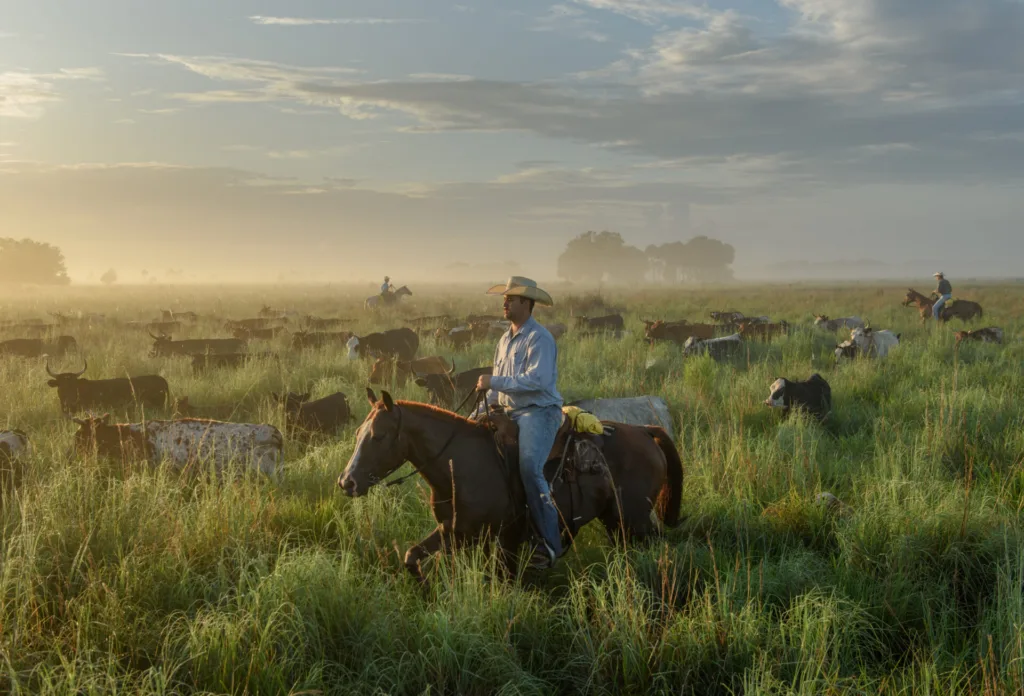
His first Florida project wasn’t about wildlife at all. It was about Florida cowboys, the ranching families who still work the state’s interior and who, like the panther, most residents never see. That book, Florida Cowboys, came out in 2009. The ranches turned out to matter for everything that followed, because much of the land wildlife moves through is private ranchland.
OMA’s chief curator, Coralie Claeysen-Gleyzon, opened her conversation with Ward about this exhibition with his own words: “This is here. This is Florida.” You can read the curator’s essay on Ward’s work for the longer story.
What Is the Florida Wildlife Corridor?
The Florida Wildlife Corridor is a connected network of public and private land, nearly 18 million acres, that lets animals move across the state instead of getting stuck on islands of habitat. About 10 million of those acres are protected. Roughly 8 million are not, and they depend on landowners and conservation partners to stay wild.
A wildlife corridor works like a road system for animals. A Florida panther needs a lot of room to hunt, find a mate, and raise kittens, and a young male may travel far to claim his own territory. If a subdivision or highway cuts the land into pieces, animals on each piece are cut off from one another.
Connected land helps people, too. According to Wildpath’s overview of the corridor, these lands protect the headwaters of the Everglades and recharge the aquifers that supply drinking water to millions of Floridians. The corridor was designated in state law on July 1, 2021, and the state has since protected more than 317,000 acres within it.
2,000 Miles on Foot: The Expeditions and Path of the Panther
Ward has traveled 2,000 miles on foot, by bike, and by paddle across two National Geographic-supported expeditions through the corridor. The first one set out from Everglades National Park on January 17, 2012. Over 100 days and 1,000 miles, Ward and his team followed the last natural path up the length of the peninsula to the Okefenokee Swamp in Georgia.
The point of the trip was to prove, in pictures, what scientists already knew: Florida’s wild places still connect, if only just. A second expedition followed, and the work grew into Path of the Panther, a 2022 documentary that won the 2024 Emmy for Outstanding Nature Documentary. You can stream it on Disney+, and Wildpath’s Path of the Panther page explains how the film was made. It drew on more than five years of fieldwork, 500,000 still images, and over 800 hours of camera-trap footage.
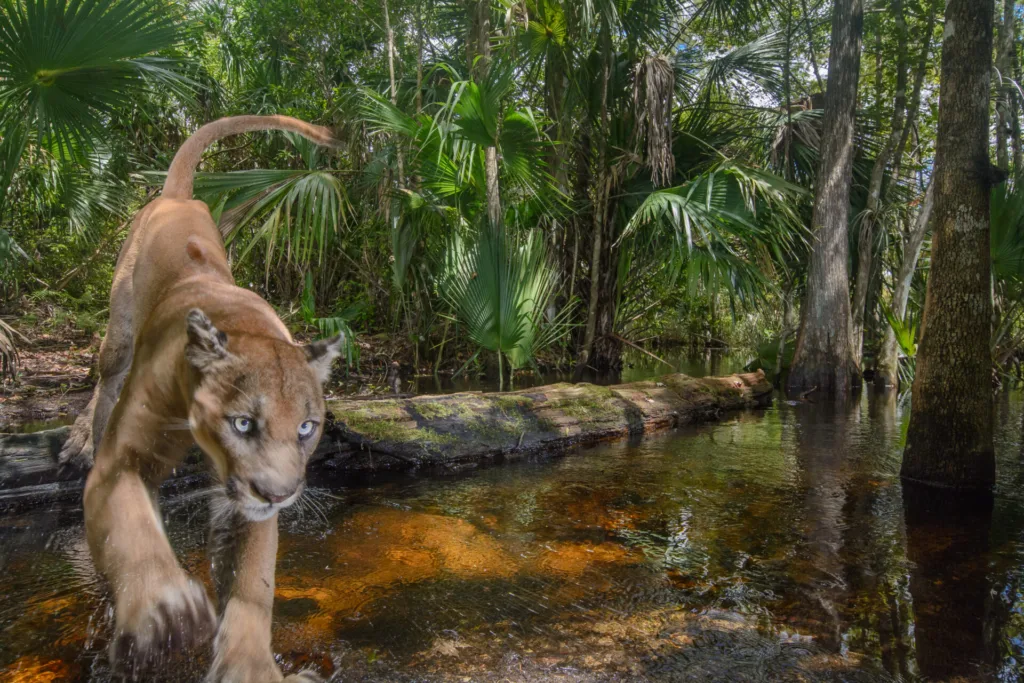
There’s good news in the panther’s story. The Florida Fish and Wildlife Conservation Commission estimates about 120–230 adult panthers live in Florida today. In the 1970s and 1980s, state and federal biologists estimated only 20–30 remained. Most of them live south of the Caloosahatchee River, but FWC has documented panthers into Central Florida, up to Orlando and occasionally farther north.
What You’ll See in the Exhibition
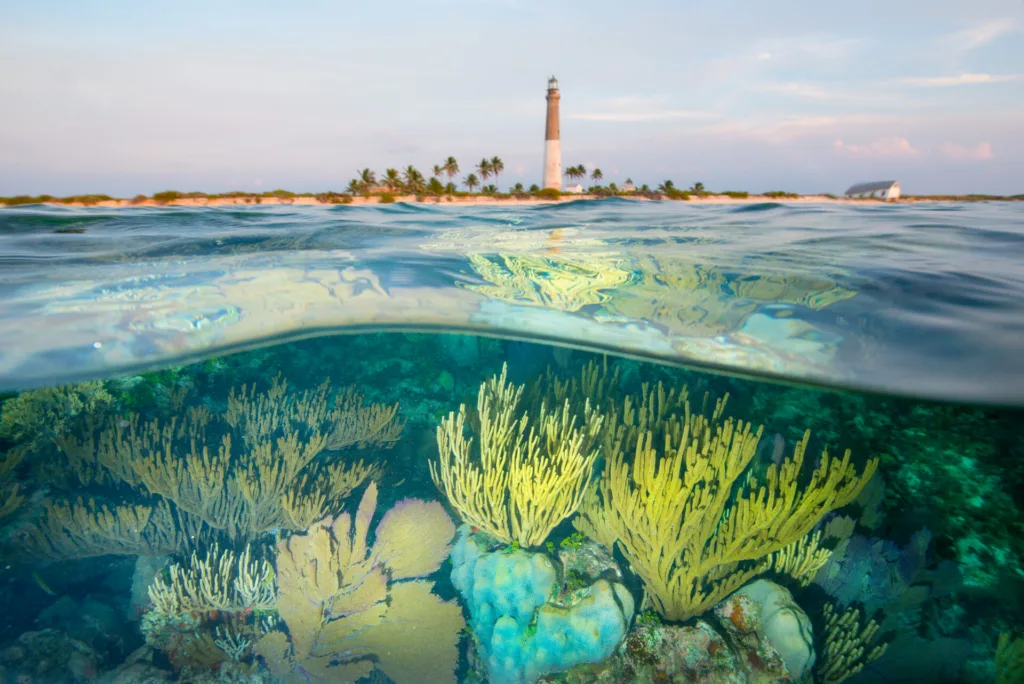
The 70 works in The Wild Path move between land and water: a Florida panther, sunrise over a working cattle ranch, a shark in Florida waters, and a lighthouse rising over a coral reef. It’s the largest exhibition of Ward’s career so far, and it pulls 20 years of work into one connected story.
A few works to look for:
- Realm of the Panther, one of Ward’s camera-trap portraits of a Florida panther.
- Sunrises, Buck Island, morning light over Buck Island Ranch, one of the working ranches that make up part of the corridor.
- Ghost Orchid Pollination, the first photograph ever to show a streaked sphinx moth probing a ghost orchid, made in the Fakahatchee Strand in 2018. The whole visit lasted about one second.
- Larry the Shark and Reef at Loggerhead Key, which carry the story offshore.
If you’d like to find your own way into the photographs, try these three things as you walk through the exhibition.
Find the camera. Many of Ward’s animal pictures come from camera traps, cameras he sets up in the woods that fire when an animal walks past. Did the animal know it was being photographed? Would Ward have had to hide the camera to get the shot?
Follow the light. Notice which photographs were taken at sunrise and which at night, then ask yourself how the light changes the place’s mood.
Check the scale. Some photographs are wide landscapes and some are close enough to count whiskers. What does a wide, panoramic view tell you that a close-up perspective can’t, and the other way around.
New to looking at photographs in a museum? Our guide on how to appreciate art at a museum is a good place to start.
Visiting With Kids
Kids will love this exhibition because the subjects are animals they’ve heard of and places they may have driven past. As you walk through, invite them to look for a Florida panther, a shark, and a moth. One part of the gallery features a screen that cycles through camera-trap photos, images captured automatically when an animal passes a hidden camera in the wild. Each photo appears only briefly, so pause there for a few minutes and see which animals your family can spot.
Questions that work well in the gallery:
- Where do you think this animal sleeps?
- What would this place sound like if you were standing there?
- If you were the photographer, where would you hide?
- Have you ever been somewhere that looks like this?
- What would this animal’s name be, and can you make up a story about them?
For families with young children, we’ve built an Art Adventures workshop around the show. The Habitat Heroes session on Friday, November 6, 2026, from 10:30 am to noon, takes children ages 2–10 and their grown-ups into The Wild Path to learn about the Florida panther’s habitat and how artists like Ward are helping to save it.
Back in the studio, kids make their own panther from air-dry clay and design a shoebox diorama for its home, decorated with natural materials. Pre-registration is required. A single workshop is $20 for one adult and one child, or $18 for members, plus $10 per additional child.
FAQs About The Wild Path
Where is The Wild Path exhibition? The Wild Path: Connecting the Florida We Don’t See is in the Brooker Grand Gallery at the Orlando Museum of Art, 2416 N. Mills Ave., Orlando, FL 32803, in Loch Haven Park. Admission details are on the museum’s Visit page.
How long is The Wild Path on view? The exhibition runs from September 25, 2026, through January 3, 2027. OMA is closed on Mondays and holidays, so check the Visit page for hours before you go.
Who is Carlton Ward Jr.? Carlton Ward Jr. is a National Geographic Explorer and conservation photographer from Tampa, Florida. He founded the Florida Wildlife Corridor project in 2010, trekked 2,000 miles across two expeditions to document it, and is the photographer behind the Emmy-winning documentary Path of the Panther.
What is the Florida Wildlife Corridor? The Florida Wildlife Corridor is a network of nearly 18 million acres of connected public and private land that lets wildlife such as the Florida panther and black bear move across the state. About 10 million acres are protected, and the corridor was recognized in Florida law in 2021.
Is The Wild Path exhibition good for kids? Yes. Photographs of panthers, sharks, reefs, and ranches give children plenty to find and talk about. On Friday, November 6, 2026, OMA’s Art Adventures workshop for ages 2–10 visits the exhibition and then makes clay panthers and habitat dioramas in the studio.
Plan Your Visit
We’d love to see you in the Brooker Grand Gallery before The Wild Path closes on January 3. The panther, the ghost orchid, and the reef all reward a second look, and kids often spot the details that grown-ups walk right past. Hours and tickets are on our Plan Your Visit page, and parking in the museum lot is free.
Access for All opens the museum free of charge on the third Thursday of each month, from 10 am to 8 pm, with gallery talks, sketching in the galleries, and a docent-led Highlights Tour at 7 pm. Festival of Trees fills the building in November, so Thursday, December 17, is your last free day to see the exhibition.
If one visit isn’t enough, become a member. Members get free admission all year, $5 off guest admission, and discounts on programs like Art Adventures, so you can come back to the panther as often as you like. While you’re here, see what else is on view in our current exhibitions.
When you get home, the Florida Wildlife Corridor Foundation, the nonprofit that grew out of Ward’s early corridor work in 2013, is a good place to keep exploring Florida in Ward’s photographs.